Florida has more than 1260 miles of coastline-more than any other state
in the continental United States. This coastline includes world famous
beaches as well as 25 percent of the country’s environmentally sensitive
wetlands, all of which represents a major economic draw for the state’s
tourist industry attracting 35.31 billion dollars in 1999 . Annually,
hurricanes and strong winter storms cause substantial erosion to
Florida’s coastline resulting in follow-up beach restoration efforts.
To
address these concerns, the Florida Geological Survey (FGS) began
coastal research studies in 1991 to locate new offshore beach
sand sources, evaluate the response of coastal wetlands to sea level
changes as well as locate and evaluate offshore springs as a potential
source of potable water.
The projects are partially funded through cooperative agreements
with various federal agencies including the United States Geological Survey, the
United States Department of the Interior Bureau of Ocean Energy Management, Regulation
and Enforcement (BOEMRE; formerly the Minerals Management Service), the National Oceanic
and Atmospheric Administration, U.S. Army Corps of Engineers and the U.S. Environmental
Protection Agency. Follow this
link to view outcomes of some of these agreements.
Resources
The Florida Geological Survey is located in the Gunter Building
on the campus of Florida State University (FSU). Research facilities at the FGS
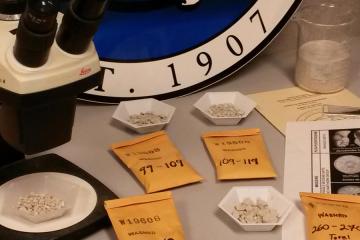
include a geological research library, a sample repository, and laboratories.
The library contains an extensive collection of state and federal publications,
periodicals, and references. The repository holds cores and well cutting samples
from more than 19,000 wells (both onshore and offshore).
Click
here to view map showing locations where cores have been collected.
Laboratory facilities include:
- a sedimentology lab containing diamond rock-saws for core
processing
- Meinzer II sieve shakers
- ovens for drying samples
- balances and sample preparation equipment for clay mineralogy,
organic/carbonate content and micro/nannofossil studies
- an alpha spectrometer to permit Pb-210 dating of recent sediments
and isotopic dating of recent carbonate sediments including cave
speleothems and coral reefs
The FGS also has cooperative agreements with several of
FSU's departments to use laboratories and analytical equipment.
Additionally, the FGS maintains an offshore geophysical data
acquisition and processing capability through equipment it
possesses, equipment possessed by cooperative research
agreements with the United States Geological Survey Coastal
Research Division in St. Petersburg, Florida, and data processing
programs licensed from various vendors.
The FGS fleet of research vessels includes:
- the 50’ RV GeoQuest (capable of extended offshore
investigations)
- the 40’ RV GeoSearch (capable of extended offshore
investigations)
- the 22’ RV GeoProbe
- a 24’ shallow draft Carolina skiff and various other small craft.
The FGS inventory of coastal field equipment includes the following
portable and vessel-deployed instruments and equipment:
- A Marine Sonics Side Scan Sonar sytem operating in 300, 600 or
1200 kHz
- An Acoustic Doppler Profiler for measuring offshore spring flow
- A Geopulse 2 to 15 kHz variable frequency subsurface acoustic
profiling system
- A Benthos CHIRP II variable frequency sub-bottom acoustic
profiling system
- A Geometrics G-881 marine magnetometer
- A seagoing vibro-core system capable of operating at water depths
up to 100'
- A jet probe for determining sediment thickness above bedrock
- A number of water quality loggers for on-site measurement of
salinity, temperature, depth, pH, conductivity, and turbidity
- A Sediment Elevation Table (SET) for measuring short-term marsh
accretion and response to storm events
- A cryogenic coring device for measuring marsh accretion rates
- An In-Situ water level indicator for determining depth to water
table in ground water monitoring wells
- FGS computer graphics equipment (for digital graphics input, as
well as publication and presentation output)
- A Hypack Vessel Navigation and digital data acquisition system
- Chesapeake Technology digital data processing software for
acquisition and processing of side scan sonar and sub-bottom
profiler data.
Current Projects
Staff have been involved in the compilation of a statewide atlas of Florida beach sediments.
All coastal county beaches have been sampled and analyzed, and a final
publication is in preparation. Also planned is the collection of high resolution acoustic profiler data
in federal waters offshore of southern Flagler, Volusia and northern Brevard counties.

The FGS has a long term relationship with the former Minerals Management Service
(now Bureau of Ocean Energy Management, Regulation and Enforcement) which utilizes FGS/ MMS funds to qualify and quantify reserves of beach sediment restoration quality sand in federal waters on the continental shelf adjacent to the coast of Florida. This has resulted in the extensive analysis of sediments off the northeast, east central and panhandle coast of Florida through the collection of geophysical data, vibracores and grab samples.
Studies in Apalachee Bay, Deadman’s Bay and Old Navy Cove to
characterize surface bottom sediments and features have been completed.
In these studies the Coastal Research Program imaged bottom features
using high resolution side scan sonar
The Offshore Springs Investigation is an innovative FGS study designed to
identify Florida’s offshore freshwater springs, characterize the spring flow and
water quality, and model the environmental impact and feasibility of diverting
spring water onshore for use by the coastal communities facing severe potable
water shortages.
The FGS has also participated in a study to characterize
the interaction between two major spring systems within the Woodville Karst
Plain (WKP). This includes quantifying the interaction between surface and
ground water in the WKP. Collectively, these studies will help in calculating
the water budget for the Woodville Karst Plain. In addition to boats, this
investigation requires flow meters, water level loggers and automatic water
samplers.
Personnel
The FGS coastal studies staff consists of a licensed Professional Geologist
who serves as principal investigator and a Marine Captain/Marine
Mechanic to operate the GeoSearch, GeoQuest, and smaller vessels.
Other full- and part-time staff are available depending on
project requirements. The principal investigator has significant
experience in Florida geology, coastal processes, continental
shelf sedimentation and marine geophysical data acquisition,
processing and analysis.
In addition, the coastal staff collaborates with various marine geology
departments around the state. This includes the University of
Florida, University of South Florida, Florida Institute of
Technology and Florida Institute of Oceanography. A
long standing cooperative relationship exists with Dr. Joe Donoghue,
a professor of coastal processes/marine geology in the geology
department at Florida State University.
This collaboration between the FGS and various university
departments provides opportunities for directed graduate research studies funded
through employment on the FGS research grants. The FGS is committed to continuing
applied research to further our understanding of Florida's coastal ecosystems
and processes. This research will provide information that is essential for
planning wise development as well as the conservation and protection of Florida's
valuable coastal resources.