The FGS SIRs database is comprised of purely voluntary data. Most insurance
providers do not send us their sinkhole testing reports or sinkhole insurance
claims locations. Since your insurance company had sinkhole testing performed at your residence you are entitled
to a copy of the report. By law (627.7073, F.S.: Sinkhole Reports), “(1) Upon completion
of testing as provided in s. 627.7072, the professional engineer or professional geologist
shall issue a report and certification to the insurer and the policyholder as provided in
this section.” If for some reason you have not received your required copy of the report
there are three avenues you can take to possibly obtain it: 1) contact your insurer,
2) contact the professional engineer/geologist of record, or
3) contact your county Clerk of Court as 627.7073 (2)(a) also requires that the
insurer file a copy of the report with the Clerk of Court in the respective county in
which the insurance claim occurred.
The Florida legislature discontinued FSRI’s funding in the early 1990’s, and
its database was transferred to the Florida Geological Survey(FGS). A brief
history is outlined below.
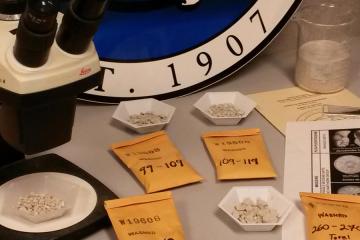
Since its inception in 1907, the Florida Geological Survey has gathered data
on Florida karst (sinkholes, caves, springs, etc.) This information is
primarily used to more fully understand the unique relationship between
karst and the state’s groundwater resources and aquifer systems.
In 1982, the Florida Sinkhole Research Institute was created at the
University of Central Florida in Orlando. At that time all FGS sinkhole data
files were transferred to the FSRI. One of their programs was to compile and
tabulate this information and convert it to a computer database. When the
Florida legislature discontinued FSRI’s funding in the early 1990’s, the FSRI
nearly ceased operations entirely. After that the database was returned to the
FGS and reformatted. Selected portions of the reformatted data were published in
1994 as FGS Open File Report 58,
“FLORIDA SINKHOLE INDEX.”
The data is currently
available as subsidence incident reports,
in a MS Excel spreadsheet format via the FGS Internet web site. As for
FSRI, they are still located at the University Of Central Florida (UCF) and
their current director is Dr. Shiou-San Kuo. He can be reached at UCF’s
Department of Civil and Environmental Engineering at (407) 823-2280.
To better understand karst processes and the features associated with it, the
FGS published
Special Publication 29, "Karst in Florida". The author, Mr. Ed Lane, did an excellent job
of explaining the various aspects of Florida Karst in an easy to understand
manner for the non-scientific community, and as a tool for teachers to use in
the classroom. Other FGS publications that discuss karst in Florida include
OFR-58, mentioned above, and
Map Series 110
which explains sinkhole types, their distribution and development.
The 1992 Florida Legislature mandated that a study of sinkhole insurance
issues be conducted. The study was completed by the Florida State University
Center for Insurance Research, under the direction of the Florida Department
of Insurance. The report, Insurance Study of Sinkholes, was submitted to the
Department in December of 1992 and subsequently to the appropriate
Legislative Committees.
Two chapters of that report were reproduced by the Florida Geological Survey as
Open File Report 72,
in response to interest from governmental agencies, the public, and the
professional community. Chapter V, deals with “Claims Standards.” It was
determined during the course of the study that a listing of typical standards
used by Professional Geologists or Professional Geotechnical Engineers was
needed to offer guidance regarding what a competent geological assessment of a
site should consider to determine if karst processes are responsible for
observed features. Chapter V is entitled “ Examination of the Establishment of
Minimum Standards for the Evaluation of Sinkhole Claims.”
Chapter VI addresses the State's need for an ongoing research resource to
understand and characterize sinkhole occurrences and to create a central
clearinghouse for the collection of sinkhole data and for its dissemination to
the public. The Chapter entitled “Need for an Ongoing Research Resource”
includes input from four state university geology departments and the Florida
Geological Survey.
The intention of the reproduction of these chapters into an Open File Report was
to make it easier for the public to obtain the results of the “Sinkhole
Standards Summit” which was organized by the authors and attended by geologic
experts from throughout the state. Their resulting consensus is presented in
Chapter V of the report. This and all of the FGS publications are available at
selected libraries throughout the state or from our library at the address shown
below. Most may be ordered online through the FGS publications website,
and a large number are viewable online from links in the FGS online List of
Publications.
FGS staff are on call at all times to receive calls from the State Emergency
Warning Point, which is part of the Department of Community Affairs. The Warning
Point acts as a clearinghouse for emergency situations of all types including
sinkhole activity throughout the Florida. Additionally, selected members of the
FGS staff respond to a multitude of requests from the public, state and federal
agencies, and consultants regarding sinkhole development or potential.